
Which Diwali Colour Combinations Work on Walls in 2026?
Four wall pairings, each with Asian Paints shade codes, cover most festive rooms in 2026. Every Diwali colour combination below names both shades and both codes, so you can ask for the exact colour at the paint shop. Three of them pair a light base with one deep shade. The fourth uses two deep shades.
- Light Butter-N, code L189, with Terracotta-N, code 0427
- Virgin Lace, code L107, with Reef Green, code 7469
- Forest, code 8418, with Coral Cove, code 8030
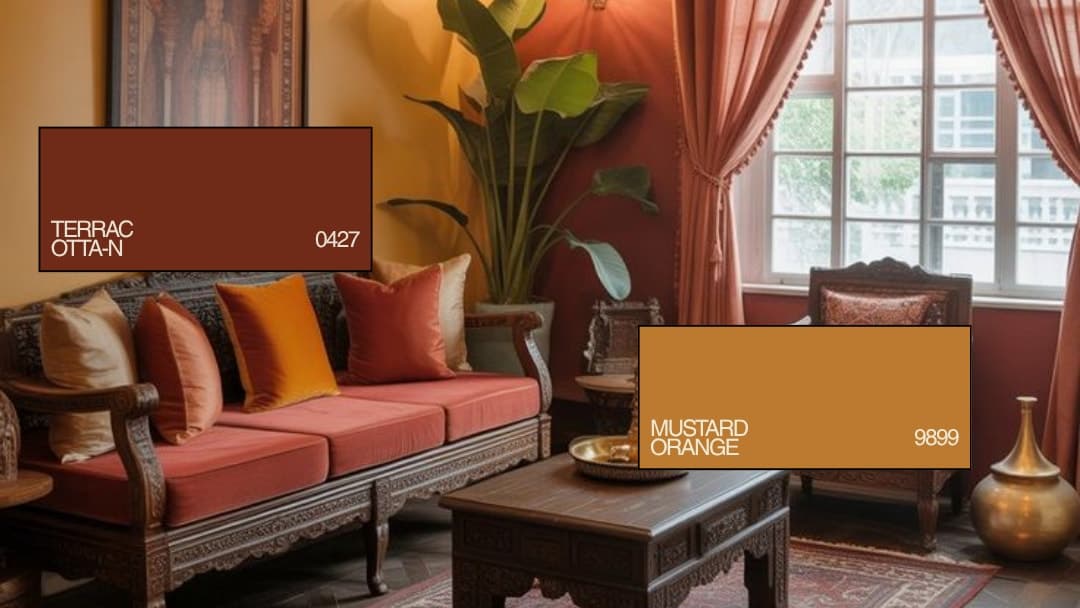
- Terracotta-N, code 0427, with Mustard Orange-N, code 9899
The same colour families turn up in the brands' own festive guides. Asian Paints lists beige with saffron and cream with gold. JK Cement lists terracotta with sage green, and Livspace lists deep green with gold accents for living rooms.
The light base with one deep shade has a money reason behind it. The deep shade covers one wall or one arch, so you buy a litre or two of it and use a standard light emulsion everywhere else. It has a calendar reason too. Diwali 2026 falls on Sunday, 8 November, and one accent wall is a weekend job while a full repaint takes over a week. If you are repainting the whole flat, our Diwali home painting guide covers the crew, the cost and the nine-day schedule.
Where Do Light Butter-N and Terracotta-N Work?
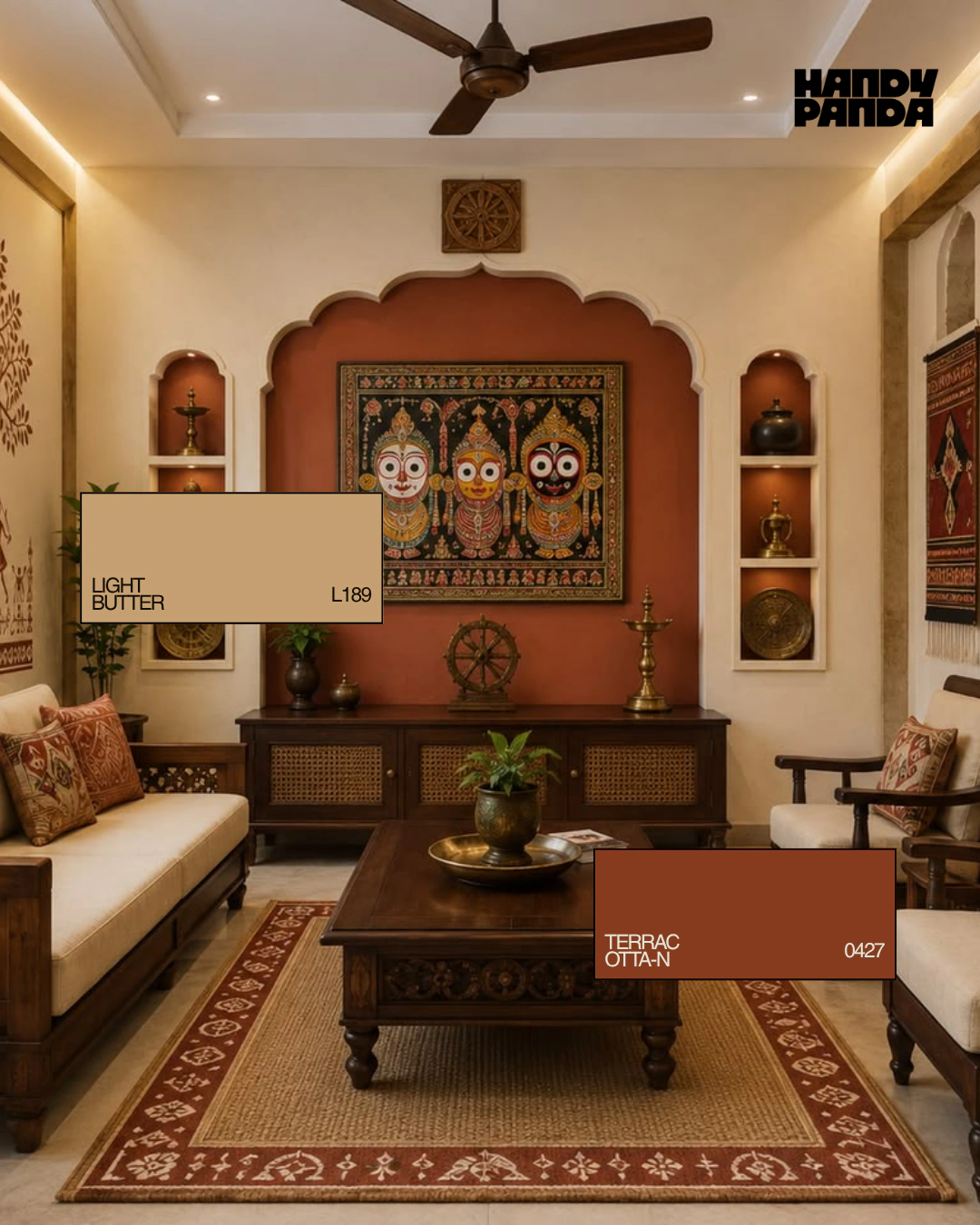
Light Butter-N on the walls with Terracotta-N on one feature wall suits a living room or a pooja corner. Asian Paints lists Light Butter-N, code L189, in its off-white family and marks it for all rooms. It lists Terracotta-N, code 0427, for highlight walls, living rooms, and doors and windows.
The split follows the 60-30-10 rule. Asian Paints gives 60 percent of a room to a dominant colour, 30 percent to a secondary colour and 10 percent to an accent. In the room above, Light Butter-N on three walls and the ceiling is the 60. Terracotta-N on the arched wall, repeated in the rug and the cushions, is the 30. The brass lamps are the 10.
Diwali decor fills the 10 percent on its own, which is why a festive room looks crowded when the walls already carry three colours. Two wall colours are enough. Let the marigold strings, the rangoli and the diyas be the third. If you want a 2026 trend shade for the base, the Asian Paints Colour of the Year is Moonlit Silk, code 7809, a warm neutral.
Where Do Virgin Lace and Reef Green Work?
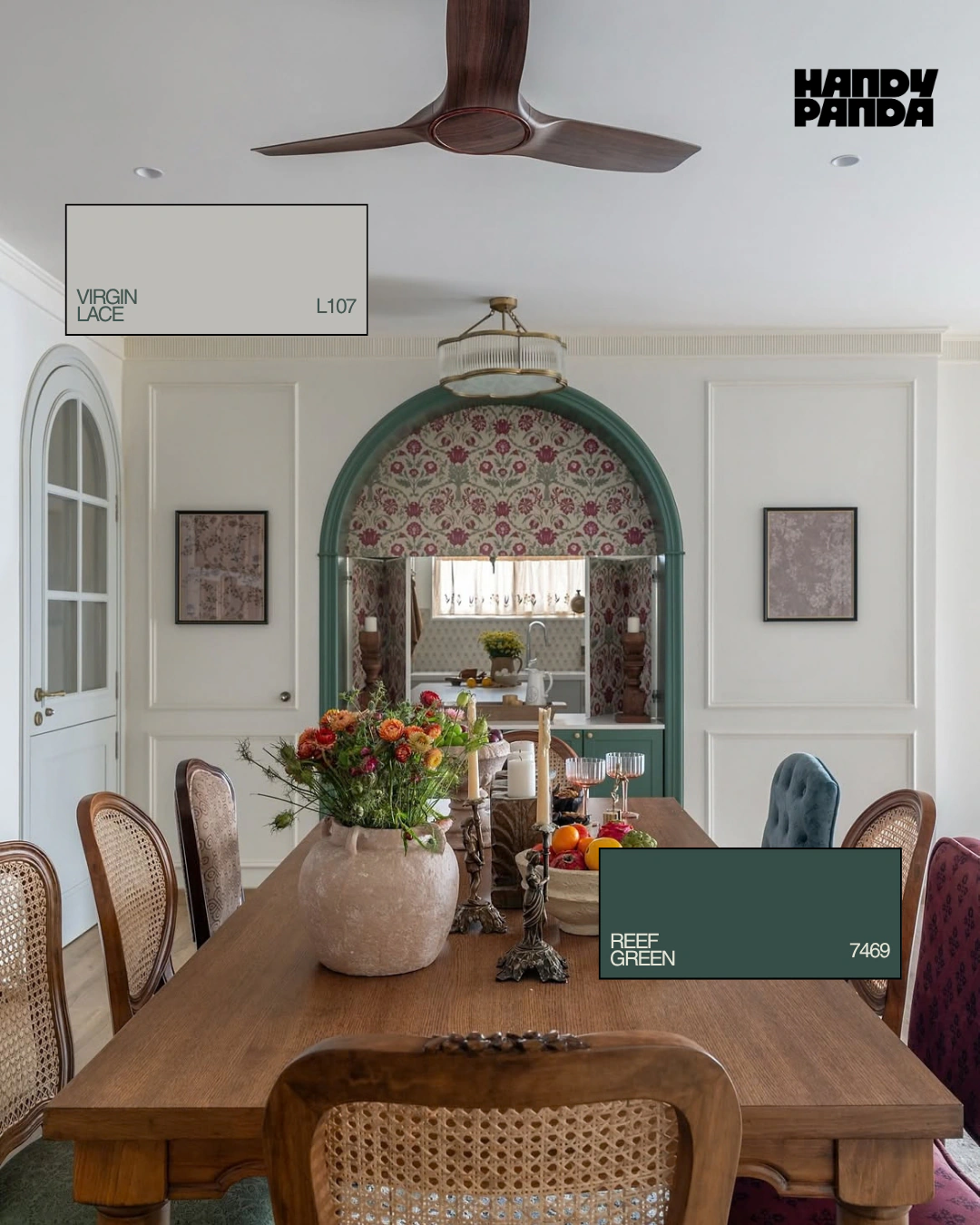
Virgin Lace on the walls with Reef Green on an arch, a niche or the door trim suits a dining room. Asian Paints lists Virgin Lace, code L107, as an off-white for all rooms. It lists Reef Green, code 7469, for living rooms, for niches and alcoves, and for exterior trims and accents.
The deep shade goes on trim here and not on a whole wall, so you need very little of it. Interior emulsion covers 100 to 130 sq ft per litre per coat. One litre of Reef Green is more than an arch surround and two door frames need for two coats. The dining room is a sound place to spend it. Berger Paints singles out the dining room for a festive refresh, because that is where guests sit.
Trim gets touched more than walls do. Matt hides surface flaws and satin wipes clean, so ask for Reef Green in a satin or sheen finish and keep the Virgin Lace walls matt. Our paint finish guide covers which finish suits which room. Livspace notes that light colours open up a small space, which is why this pairing works in a compact flat.
Where Do Forest and Coral Cove Work?
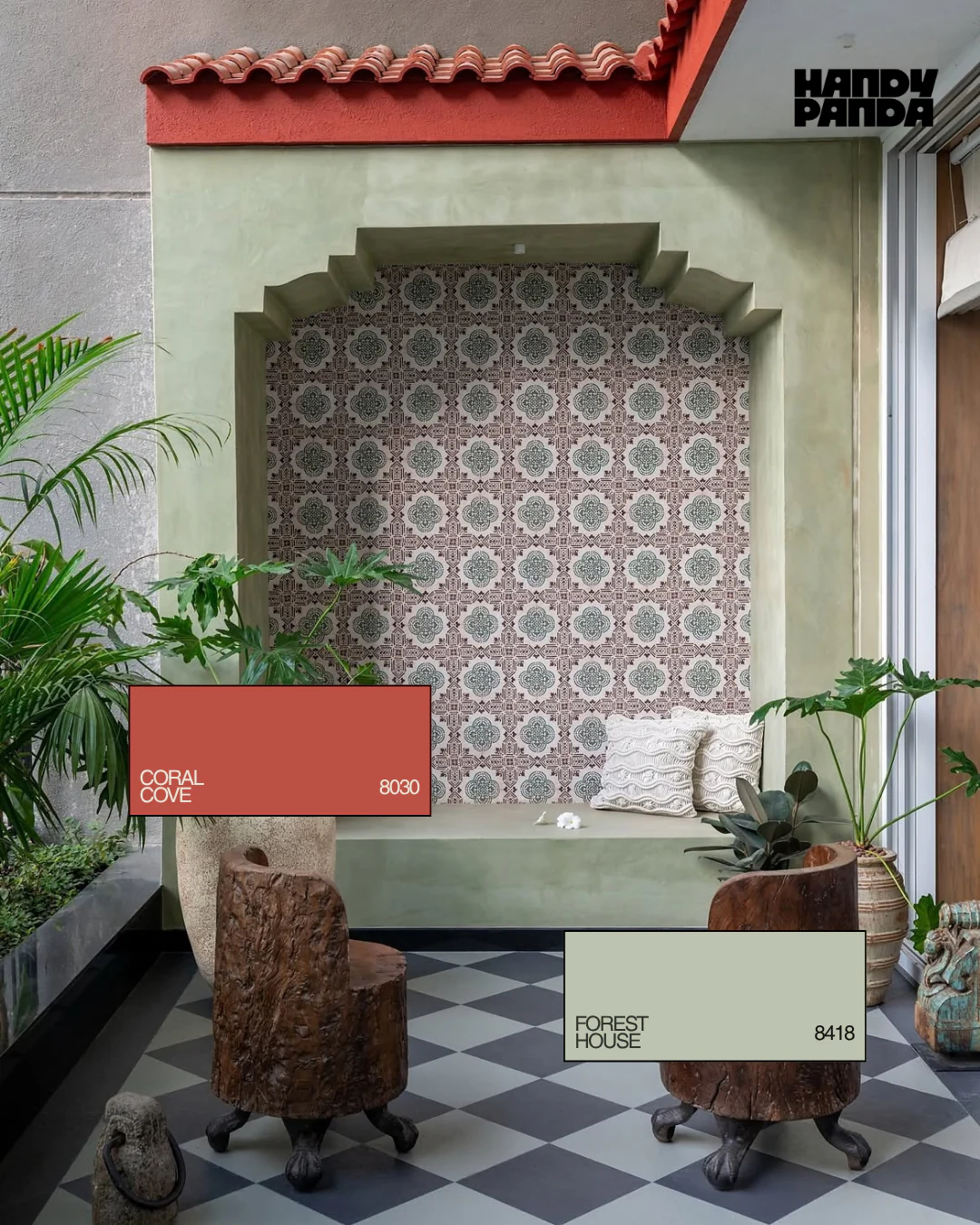
Forest on the walls with Coral Cove on a band or a border suits a balcony, a verandah or a sit-out. Asian Paints lists Forest, code 8418, for bedrooms, study rooms and the exterior body of a house. It lists Coral Cove, code 8030, for living rooms, dining rooms and balconies.
Green with red is on two brands' Diwali lists. Asian Paints ties green to luck and growth and calls red a colour of celebration. Berger Paints names green with red among its festive pairings, and suggests an accent on the balcony wall. Forest is a pale green, so the pairing stays quiet in daylight and the Coral Cove band carries the festive part.
A balcony wall is an outdoor wall. Ask for both shades in an exterior emulsion, because an interior emulsion is not built for sun and rain. Our interior vs exterior paint guide explains the difference, and the exterior painting guide for Diwali covers the cost and the dry-weather window.
Where Do Terracotta-N and Mustard Orange-N Work?
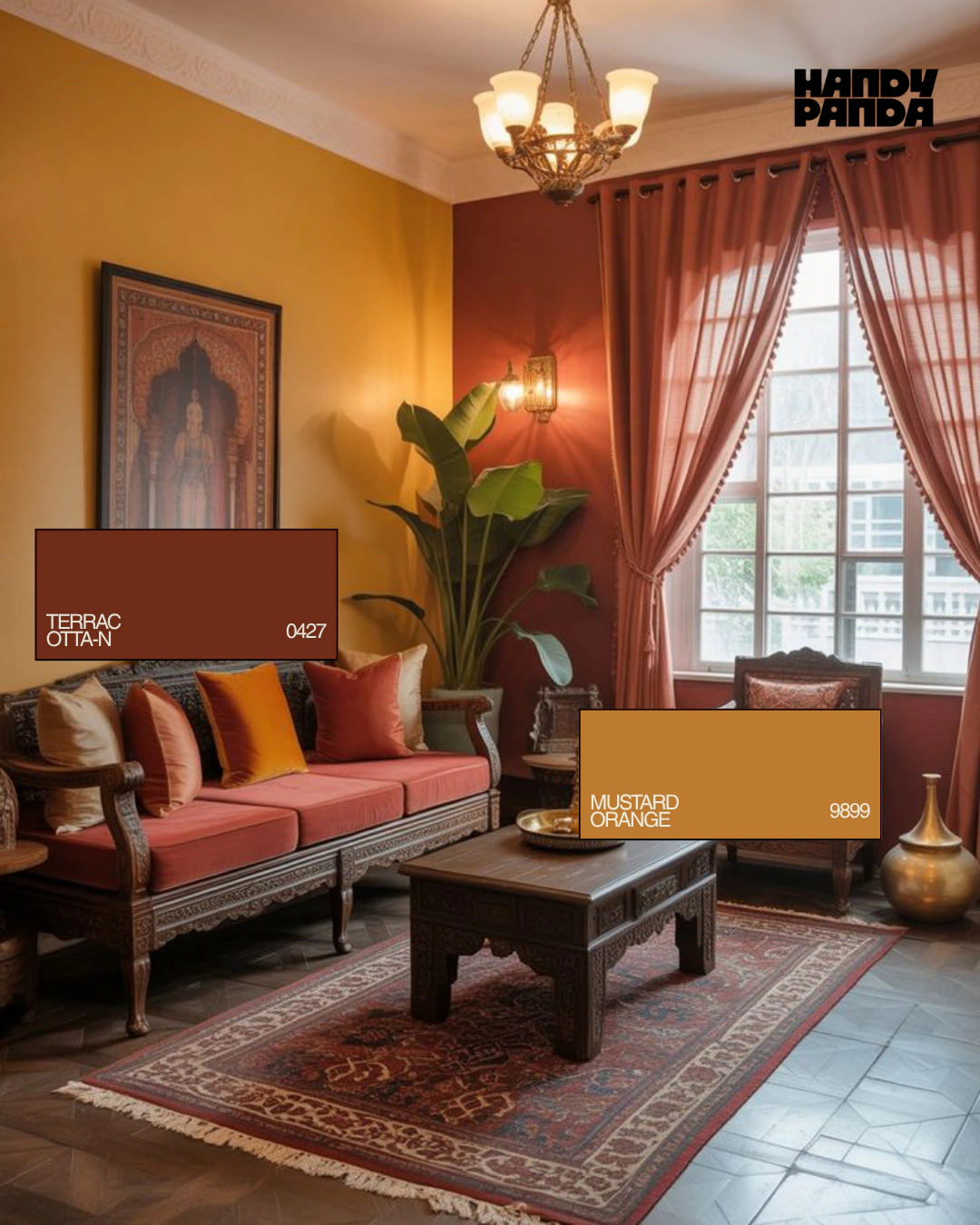
Terracotta-N with Mustard Orange-N suits a living room that you use mostly in the evening. Both shades are deep. Asian Paints lists Mustard Orange-N, code 9899, for highlight walls, verandahs and balconies. It lists Terracotta-N, code 0427, for highlight walls and living rooms.
Warm light is the reason this pairing works at night. Clare, a paint maker, notes that warm white bulbs bring out creams, beiges and terracottas, while cool white bulbs pull out blue, green and grey undertones. A diya flame and a string of warm fairy lights sit at the warm end, so both shades look richer on Diwali night than they do at noon. Our LED lighting guide explains the warm white and cool white ratings printed on the bulb box.
Two deep walls make a room feel smaller. Livspace notes that dark colours make a space feel closer, and Clare notes that north-facing rooms make colours look darker and cooler than the swatch. In a small or north-facing room, keep Mustard Orange-N on one wall and use Light Butter-N, code L189, on the others.
Which Colours Suit the Pooja Room and the Entrance?
Yellow, orange and white lead the pooja room colour lists, and dark shades stay out. Asian Paints names four shades for the pooja room: Tangerine Yellow-N, code 9874, Orange Crush, code 7959, Absolute White, code L161, and a green called River Cruise, code 7680. The same guide advises against darker shades and black in this room.
Asian Paints gives a reason for each. Orange and yellow match the flowers offered at the altar, and orange pairs with brown accents such as a wooden mandir. White goes with a white marble base, since the wall and the stone read as one surface. For pattern, Asian Paints suggests a mandala on the pooja room wall, or a gold texture on one wall when the mandir shares space with a bedroom or living room.
The entrance has less wall area and more eyes on it. Berger Paints suggests stencil strips at the doors. Asian Paints lists Terracotta-N, code 0427, for doors and windows, so the shade from your feature wall can repeat on the main door frame. Keep the leftover paint. It covers the touch-ups before next Diwali.
How Do You Test and Buy a Shade by Its Code?
Test the shade on your own wall first, then buy it by code. Asian Paints sells a painted sample called Swatch Select, 30 cm by 30 cm, for ₹250 including taxes as of September 2026. Tape it to the wall and look at it in the morning, in the afternoon and after dark with your own lights on. Clare suggests living with a sample for a day or two.
Carry the code, because shade names sit close to each other. Asian Paints has a Coral Cove, a Coral Coast and a Coral Beach, with codes 8030, 8016 and 7969. Some names end in N, such as Terracotta-N and Light Butter-N. The suffix is part of the name, so read it out along with the code.
Codes do not carry across brands. Birla Opus has its own festive reds and mustards, such as Roses are Red, RR 3085, and Motichoor, YY 1070. Decide the brand first and the shade second. Then check three things at the counter. The code on the tin label matches the code you asked for. Every tin of one colour carries the same batch number. The bill lists the shade code, because you will want it for a top-up two years from now. Shops mix most deep shades to order by adding colourant to a base, and many will not take a tinted tin back.
How Much Paint and Time Does an Accent Wall Take?
One accent wall takes about two litres of paint and a weekend. A wall 12 feet wide and 10 feet high is 120 sq ft. Interior emulsion covers 100 to 130 sq ft per litre per coat, so two coats need roughly two litres, plus 10 percent for the roller and tray. Our paint quantity guide has the full formula.
Texture finishes cost more. As of August 2026, Aapkapainter puts interior texture paint in Delhi NCR at ₹35 to ₹65 per sq ft, which makes that 120 sq ft wall a ₹4,200 to ₹7,800 job. A texture or stencil specialist charges ₹1,200 to ₹1,800 a day.
On timing, Asian Paints advises painting two to three weeks before Diwali, so the paint sets and you still have days left to decorate. With Diwali on 8 November 2026, that means starting between 18 and 25 October. A deep colour over a light wall often needs a third coat, so leave a spare day. Buy the primer, putty, masking tape and rollers along with the paint so the job does not stop midway. HandyPanda delivers paint and painting supplies across Gurgaon in under 60 minutes if a tin runs short on the day.