
Which GRAP Stage Is Gurgaon In Right Now?
As of 27 October 2026, Gurgaon is in GRAP Stage I. Stage I does not stop work on most houses. Work on a plot of 500 sq m or more stops if the project is not registered on the state portal or breaks dust rules (page 2). GRAP is the Graded Response Action Plan, Delhi NCR's pollution rules. The Commission for Air Quality Management (CAQM) started Stage I for all of NCR on 21 October 2026, when Delhi's air quality number (AQI) reached 244, newsonair reported. It was still in force on 26 October, per NewsDrum.
The stage goes by Delhi's AQI, but the rules apply in Gurugram district too. The CAQM GRAP schedule, revised on 29 September 2026, sets four levels on page 1:
- Stage I, Poor: AQI 201 to 300
- Stage II, Very Poor: AQI 301 to 400
- Stage III, Severe: AQI 401 to 450
- Stage IV, Severe+: AQI above 450
Each stage keeps the rules of the stages before it. CAQM can also start a stage early, when the weather forecast says the air will get worse. Before you call your workers (mistri), check the live stage on the CAQM GRAP page.
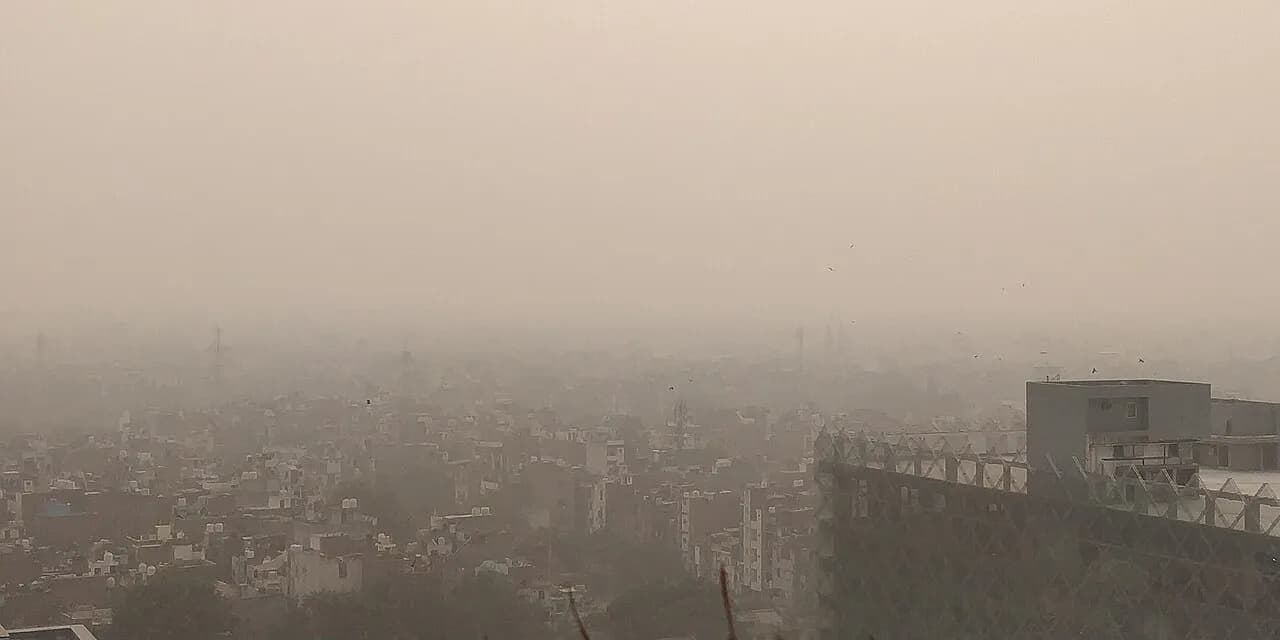
Top photo: smog over Delhi, December 2019, by Prami.ap90, CC BY-SA 4.0, via Wikimedia Commons.
What Construction Work Stops Under GRAP Stage 3?
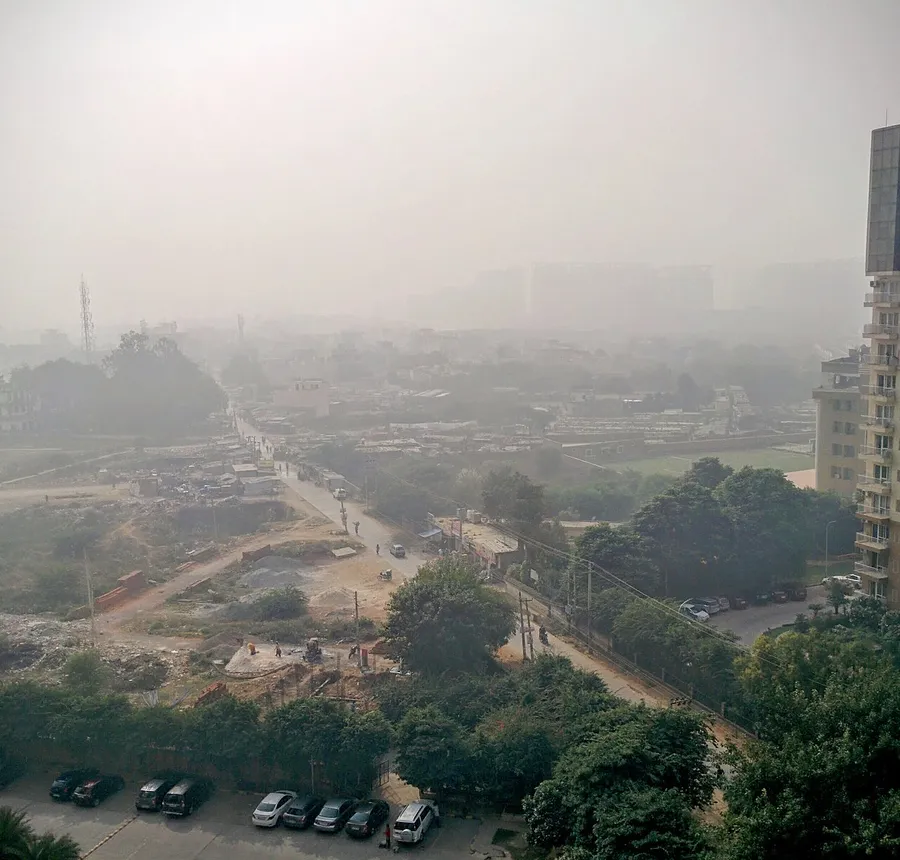
Smog over Gurgaon, November 2016. Brick stacks and loose stone on kachcha tracks are what Stage III targets. Photo by Saurabh Kumar, CC BY-SA 4.0, via Wikimedia Commons.
Say your painter is halfway through your builder floor when Stage III starts. He has to stop. Item 1(i) of the Stage III list in the CAQM GRAP schedule (pages 11 and 12) stops these dusty jobs in all of Delhi NCR:
- Digging and filling earth, including boring and drilling
- Piling, for deep foundation posts
- All demolition (breaking walls)
- Laying sewer, water, drain or electric cable lines in open trenches
- Brick and masonry work
- Ready-mix concrete plants, where concrete is mixed for trucks
- Big welding and gas cutting. Small welding for electrical and plumbing work is allowed.
- Painting, polishing and varnishing
- Cement, plaster and other coatings, except small repairs inside the house
- Cutting, grinding and fixing tiles, stone and flooring, except small repairs inside the house
- Loading and unloading cement, fly ash, bricks, sand, red soil (murram), pebbles and crushed stone
- Trucks with building material or debris on unpaved (kachcha) roads
Painting, polishing and varnishing get no exception for small repairs. A half-painted flat stays half-painted until the stage comes down.
This is not only for big builders. Page 11 lists "all construction agencies and plot owners (both public & private)" among the people responsible.
Can You Get Cement and Sand Delivered During Stage 3?
Your contractor (thekedar) calls and says the sand truck cannot unload. The Stage III list stops loading and unloading of cement, fly ash, bricks, sand, red soil, pebbles and crushed stone "anywhere within / outside the project sites" (page 11 of the CAQM GRAP schedule). The order does not limit this to large sites, so we read it as covering a delivery to a house too.
Stage III also shuts stone crushers and all mining in NCR (page 13). Haryana has to strictly limit older BS-III petrol and BS-IV diesel cars in Gurugram (page 13). A BS-IV or older diesel goods vehicle from outside Delhi cannot enter Delhi (pages 13 and 14). Ask your contractor early if he uses an old diesel car, or an old diesel pickup that goes to Delhi.
So order early. Get cement and tile adhesive delivered while Stage I or II is on, and finish wet work before Stage III. As of 27 October 2026, UltraTech PPC cement costs ₹365 per 50 kg bag on HandyPanda, or ₹350 a bag for 100 bags or more. Keep the bags covered. Stage I already asks you to store and cover building material on site (page 2).
What Home Work Can Continue During GRAP Stage 3?

Your kitchen carpenter asks if he can keep working. Yes, but polish and varnish on the wood stop (page 11). Item 1(ii) of the CAQM GRAP schedule (page 12) allows other building work that is "relatively less polluting / less dust generating", that is, work with little dust. It still has to follow the dust rules. The 2026 schedule does not list these jobs.
An older CAQM order did. When Stage III started on 2 November 2023, it allowed "plumbing works, electrical works, carpentry related works", according to PIB. None of these jobs is on the 2026 stop list. Work that fits:
- Changing switches, sockets and MCBs (circuit breakers) on old wiring
- Pulling new wire through the pipes already in the wall
- Fitting taps, angle valves, showers, geysers and bath fittings
- CPVC and PVC pipe work that needs no open trench
- Putting together a modular kitchen or wardrobe from ready-cut plywood
- Fitting hinges, drawer channels, handles and locks
Cutting grooves in a wall for new wire pipes makes dust. Cutting tiles to reach a pipe counts as tile work, which stops except for small repairs inside the house. Do the wall cutting before Stage III.
Does GRAP Stage 4 Change Anything for a Home Project?
For your house, no. GRAP Stage 4 adds no new building rule for a private home. Item 3 of the Stage IV list (page 16 of the CAQM GRAP schedule) stops the same work on government projects such as highways, roads, flyovers, power lines, pipelines and telecom lines. Under Stage III, those projects can carry on (page 12). A private house never had that exception. So in Stage IV, the Stage III list is still the full list for your site.
Stage IV does make your week harder. Heavy trucks cannot enter Delhi, except trucks that run on LNG, CNG, electric or newer BS-VI diesel (page 16). State governments can also think about closing non-emergency shops and offices, or an odd-even rule for cars (page 17). If Haryana does this, a trip to the hardware market or a delivery may take longer.
Last winter, Stage IV ran from 13 December to 24 December 2025. When CAQM lifted it, Delhi's AQI was 271, and all Stage III rules stayed, newsonair reported. Stage III ended on 2 January 2026, and private building work could start again, per IANS.
What Work Needs Finishing Before GRAP Stage 3?
Diwali is close, or there is a wedding in the family. Finish the wet and dusty work first: painting, polishing, varnishing, plaster, tiling, brickwork and breaking work. All are on the Stage III list (page 11 of the CAQM GRAP schedule). The Stage II advice for the public asks people to avoid dusty building work from October to January (page 10).
In each of the last three winters, Stage III started in November:
- 2023: 2 November, PIB
- 2024: 15 November, from 8 am, PIB
- 2025: 11 November, when Delhi's AQI hit 425 at 9 am, PIB
It came back on 13 December 2025, and again from 16 to 22 January 2026, per the CAQM order of 22 January 2026. The same order shows Stage I started on 14 October in 2025. This year it started on 21 October. Past dates do not predict 2026, but they show how little warning you may get.
Diwali falls on 8 November 2026, per the Delhi central government holiday list. For walls ready by the festival, end the paint job before any Stage III order. Our guide to exterior wall painting before Diwali covers timing and cost.
Which Materials Do You Need for Each Kind of Work?

Buy material for dusty work now. Buy material for allowed work as each job needs it. The prices below are live HandyPanda prices as of 27 October 2026.
For work that can go on in Stage III.
- Electricals has wire, switches, MCBs and distribution boards. A Havells 16 A single-pole MCB costs ₹130.
- Bath accessories and CPVC, PVC and GI fittings have taps, angle valves, showers and pipe joints. The Jaquar brass angle valve above costs ₹564 and has a 10-year warranty.
- Plywood and channels and hardware have boards, hinges, drawer channels and handles for kitchens and wardrobes. A Hettich 18-inch ball-bearing drawer channel for up to 45 kg costs ₹341. Fevicol SH wood glue costs ₹167 for 500 g.
For work to finish before Stage III.
- Paint, primer and putty for every room.
- Cement for plaster and brickwork. UltraTech PPC costs ₹365 per 50 kg bag.
- Tile adhesive and grout for tiling. Roff T01 tile adhesive costs ₹278 per 20 kg bag.
Electrical work fits a Stage III week. Our guide on upgrading home electricals safely gives the order of work. The MCB rating guide helps you pick the right breaker for each circuit.
Is Interior Work Allowed in GRAP 3 and GRAP 4?
Is interior work allowed in GRAP 3? Partly. Plumbing, electrical work and carpentry fitting are not on the Stage III stop list. They can go on under the dust rules (page 12 of the CAQM GRAP schedule). Plaster, cement work and tile work stop, except small indoor repairs. Polish and varnish on wood stop too (page 11).
Is interior work allowed in GRAP 4? The same as GRAP 3 for a private house. The only new Stage IV building rule is for government road, pipeline and power line projects (page 16).
Is house painting allowed in GRAP 3? No. The schedule stops "painting, polishing and varnishing works" with no small-repair exception (page 11).
Does my project need to be registered? Only if the plot is 500 sq m or more. From Stage I, it needs registration on the state web portal. Without it, the site cannot work (page 2).
What is the fine for breaking GRAP rules? The 2026 schedule gives no fine amounts. A site closed for breaking the rules needs a special CAQM order to restart, even after the stage ends, per para 5 of the CAQM order of 22 January 2026.