
What Is a Cement Mix Ratio and Why Does It Matter?
A cement mix ratio tells you exactly how much cement, sand, and aggregate to combine for a specific construction task. Get the ratio wrong and your slab could crack within months — or you waste money using more cement than needed.
The ratio is written as cement : sand : aggregate by volume. So 1:2:4 means 1 part cement, 2 parts sand, 4 parts aggregate. For mortar used in plastering and brickwork, there's no aggregate — just cement and sand, like 1:6.
In India, these ratios correspond to concrete grades defined by the Bureau of Indian Standards. M15 means the concrete can handle 15 MPa of compressive strength after 28 days of curing, according to UltraTech Cement. The "M" stands for mix and the number is strength in megapascals. Different jobs need different strengths — your foundation needs stronger concrete than a garden pathway. Using M25 where M10 would do wastes cement and money.
Which Concrete Grade and Ratio Do You Need?
Each concrete grade has a fixed cement:sand:aggregate ratio. Here is the complete table used across Indian construction, as documented by UltraTech Cement.
M5 (1:5:10) — lean concrete for levelling rough ground. M7.5 (1:4:8) — PCC flooring and wall foundations. M10 (1:3:6) — single-storey foundations and pathways. M15 (1:2:4) — driveways, internal flooring, and non-structural work at 15–20 MPa. M20 (1:1.5:3) — the standard for residential RCC slabs, beams, and lintels. M25 (1:1:2) — heavy load-bearing columns, high-rise foundations, and water tanks.
For most Gurgaon homes you'll mainly use three: M7.5 or M10 for PCC and foundations, M20 for slabs and beams, M25 for columns. If your contractor suggests M15 for a roof slab, that's a red flag — M20 is the minimum for any RCC work. To understand which cement type suits each grade, read our OPC vs PPC cement guide.
What Ratio Should You Use for RCC Slabs and Columns?
RCC (Reinforced Cement Concrete) forms the structural skeleton of your house. The ratio depends on the load each element carries, according to Civil Sir.
Roof slabs and beams use M20 at 1:1.5:3 — roughly 20 MPa strength, enough for typical residential floor loads of 2–4 kN/m². If you're building a 3BHK on Sohna Road, your entire slab uses this mix.
Columns need M25 (1:1:2) because they bear the full weight of every floor above them. A ground-floor column in a two-storey house supports roughly twice the load of a first-floor column — a weaker mix for lower storeys compromises structural safety.
Lintels above doors and windows typically use M20 (1:1.5:3) since their span is short. One practical check: for 1 cubic metre of M20 concrete you need about 8 bags (400 kg) of cement, 0.44 m³ sand, and 0.88 m³ aggregate. If your contractor is pouring a 10 m³ slab and ordered only 50 bags — ask questions.
What Are the Right Cement-Sand Ratios for Plastering?
Plastering ratios depend on location — inside, outside, or overhead. Exterior and ceiling plaster needs a richer mix (more cement) than interior walls, according to Civil Sir.
Internal wall plaster uses 1:6 (1 cement : 6 sand) — the standard you'll see in any Gurgaon apartment. For finer sand, 1:5 works better. Coat thickness runs 12–15 mm.
External wall plaster needs 1:4 for both coats. CPWD specifications recommend a 1:5 undercoat with coarse sand plus a 1:4 topcoat with fine sand. External plaster is thicker at 15–20 mm because it faces rain, sun, and temperature swings.
Ceiling plaster uses a richer 1:3 or 1:4 mix. Gravity pulls against it, so stronger adhesion is essential. Ceiling coats run thinner at 6–8 mm. The bearing plaster applied on top of walls before laying the RCC slab uses an even richer 1:2 ratio for full contact between wall and slab. Once plastering is done, check our paint finish guide for the right topcoat.
What Ratio Works Best for Brickwork and Masonry?
Brickwork ratios depend on wall thickness. Thinner walls need richer mortar to compensate for less structural mass, according to Gharpedia.
Half-brick walls (4-inch / 100 mm) used for partition walls inside your home need 1:4 cement-sand mortar. These non-load-bearing walls rely on mortar for stability, so the richer mix is essential.
Full-brick walls (9-inch / 230 mm) for external walls and load-bearing structures use 1:6 mortar. The thicker wall provides structural strength on its own, so the mortar mainly bonds the bricks together.
Foundation brickwork below ground level uses 1:6 in normal conditions. In areas with high water tables — common in parts of Sohna Road — your engineer may specify 1:4 or add a waterproofing compound.
Watch for a common shortcut: mortar mixed at 1:8 or weaker to save cement. At Gurgaon prices of ₹350–₹420 per bag, the saving is ₹30–₹50 per bag — insufficient for long-term structural integrity. If the mortar looks unusually sandy, check our cement quality guide to verify materials.
What Mix Do You Need for PCC Flooring and DPC?
PCC (Plain Cement Concrete) and DPC (Damp-Proof Course) appear in every house construction but homeowners rarely discuss them, according to UltraTech Cement.
PCC flooring — the base layer before your tiles — uses M7.5 grade at 1:4:8 (cement:sand:aggregate). It is also poured below foundations for levelling. Typical thickness: 75–100 mm for floors, 150 mm under foundations.
DPC is a horizontal layer at plinth level that stops ground moisture from rising into your walls. It uses M15 (1:2:4), usually mixed with a waterproofing compound. Standard thickness: 25–40 mm. Skip DPC and within a few years you'll see damp patches and peeling paint on ground-floor walls.
Lean concrete — M5 at 1:5:10 — is the weakest grade, used only for levelling rough ground before proper foundations. It carries no structural load. Ask your contractor to add waterproofing liquid to the DPC mix — brands like Dr. Fixit or Fosroc cost ₹200–₹400 extra per bag-equivalent area but prevent lakhs in damp repairs later. If walls already show moisture damage, see our waterproofing methods guide.
How Do You Calculate Cement Quantities for a Mix?
Knowing the ratio is step one. Calculating how many bags you actually need prevents over-ordering and contractor padding, according to JK Cement.
The key number: 1 cubic metre of wet concrete requires 1.54 cubic metres of dry materials because dry ingredients compact when water is added.
For M20 (1:1.5:3): total parts = 1 + 1.5 + 3 = 5.5. Cement volume = (1 ÷ 5.5) × 1.54 = 0.28 m³. One 50 kg bag = 0.035 m³. Result: 0.28 ÷ 0.035 = 8 bags per cubic metre. Sand = 0.42 m³ (~15 cubic feet). Aggregate = 0.84 m³ (~30 cubic feet).
For M15 (1:2:4): total parts = 7. Cement = (1 ÷ 7) × 1.54 = 0.22 m³ ≈ 6.3 bags. Fewer bags because the mix has proportionally more sand and aggregate.
Quick reference: order 8 bags/m³ for slab work (M20) and 6.5 bags/m³ for PCC and flooring (M15). Always add 5% for spillage. To verify the grade printed on your cement bag, see our cement grades guide.
What Is the Right Water-Cement Ratio?
Too much water makes weak concrete. Too little makes it unworkable. The water-cement ratio — weight of water divided by weight of cement — directly controls final strength, according to JK Cement.
For M15 (1:2:4), use a water-cement ratio of 0.50–0.60 — roughly 25–30 litres per 50 kg bag. For M20 (1:1.5:3), aim for 0.45–0.50 — about 22–25 litres per bag. M25 needs 0.40–0.45.
A frequent issue on construction sites: workers add extra water so the mix pours easily. Every extra litre beyond the specified ratio reduces strength by 5–10%. If you see workers hosing down an already-mixed batch, raise it with your site supervisor.
How to spot over-watered concrete: a proper mix holds its shape briefly on a trowel. If it flows like batter, it's too wet. If it crumbles, too dry. For a reliable check, ask your supervisor to do a slump test — pour fresh mix into a cone mould, lift it, and measure the sag. For residential slabs, 75–100 mm of slump is the target range per IS 456.
How Can You Verify Your Contractor Is Using the Right Mix?
You don't need an engineering degree to spot-check cement ratios on site. A few practical checks go a long way, based on practices recommended by Gharpedia.
Count the bags. Before a slab pour, calculate how many you need using the formula above. If your contractor ordered 60 bags for a 10 m³ slab but M20 needs ~80 — that's a gap worth questioning.
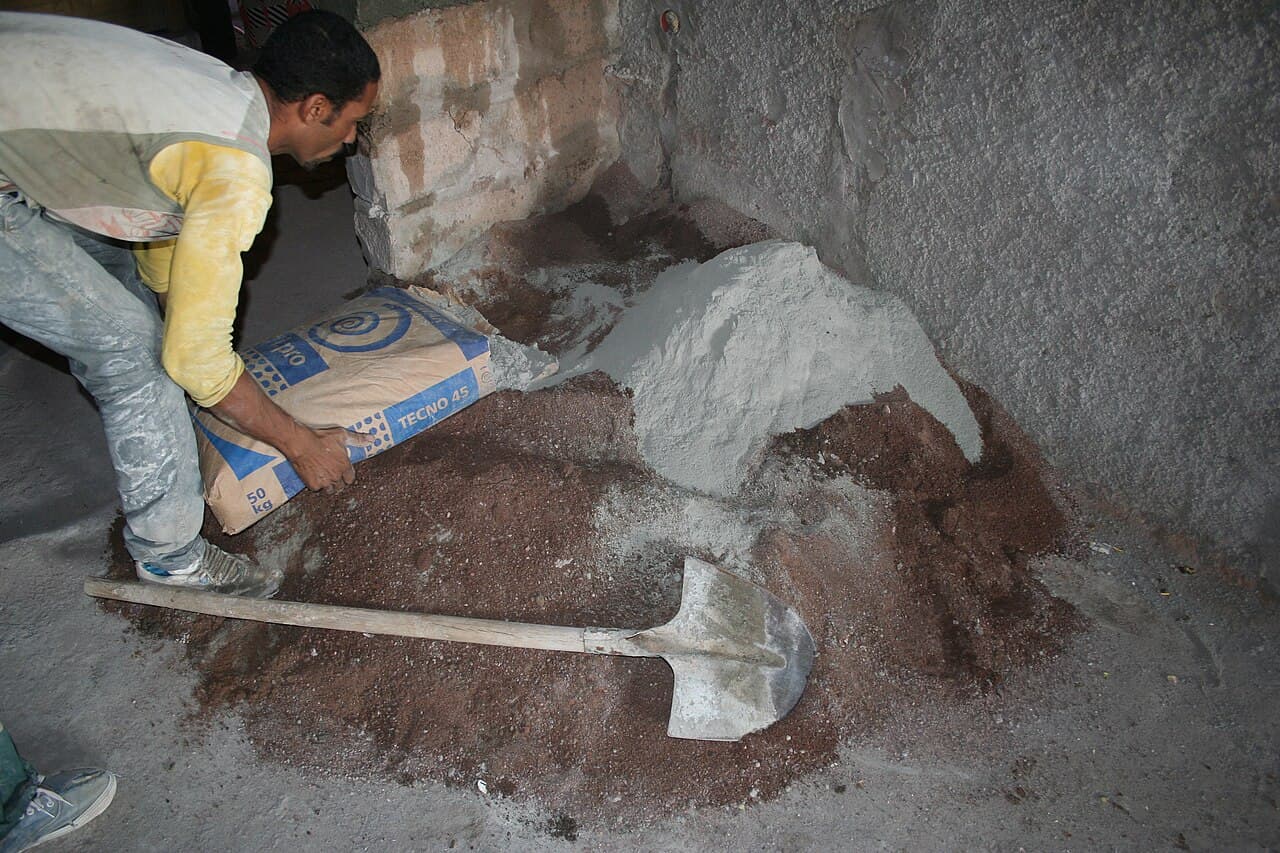
Watch the mixing. On Gurgaon residential sites, workers measure with "farrhas" — boxes or buckets, typically 1 cubic foot each. For 1:1.5:3, you should see 1 farrah cement, 1.5 farrahs sand, 3 farrahs aggregate per batch. Count the scoops.
Check the sand quality. Grab a handful and rub it between your palms. If it stains brown, there's too much clay content and the mix will be weaker. Good sand feels gritty and stays clean.
Check the aggregate. Stone chips should be angular (not rounded) and 12–20 mm for residential slabs. Rounded pebbles bond poorly with cement. If you're ordering cement yourself, HandyPanda delivers across Gurgaon including Sohna Road, DLF Phase 1–5, and Palam Vihar.